
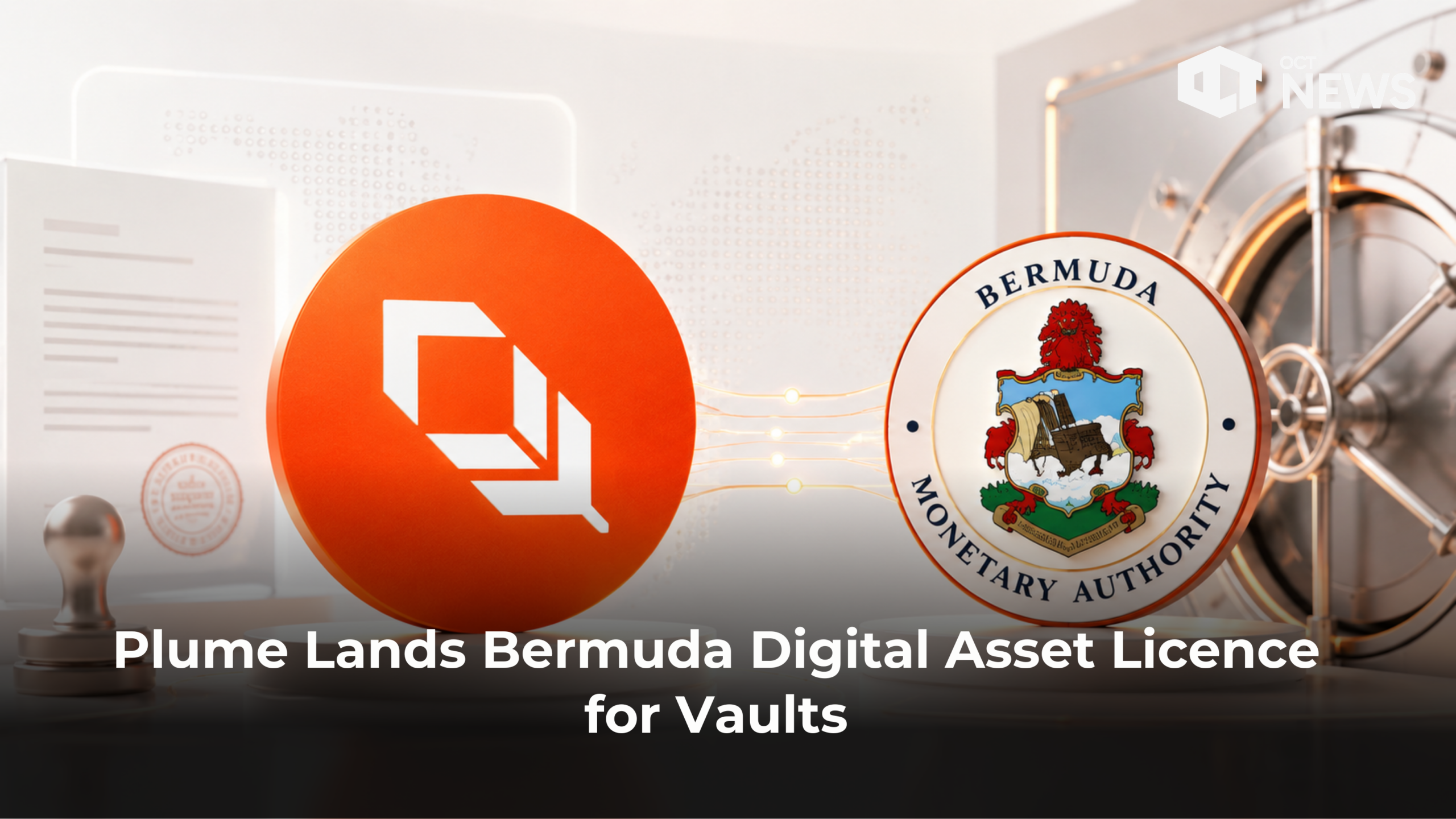
8th June 2026. Plume Lands Bermuda regulatory approval as its subsidiary KDAB secures a Bermuda digital asset licence from the Bermuda Monetary Authority. The approval clears a path to what Plume calls the world’s first regulated onchain vaults. The regulator granted the Class M licence on May 20, and Plume resurfaced the news this week while promoting a June 11 webinar.
High Signal Summary For A Quick Glance
- Plume’s Bermuda subsidiary KDAB received a Class M Digital Asset Business Licence from the Bermuda Monetary Authority on May 20, 2026, under the Digital Asset Business Act 2018
- Plume calls KDAB the first regulated onchain vault manager cleared to create and distribute vault tokens, setting up what it calls the world’s first regulated onchain vaults
- The Class M licence is time-limited and conditional, requiring AML, liquidity, cybersecurity, and wind-down safeguards under heightened BMA supervision
- Institutional and retail investors seeking regulated, compliant access to tokenized real-world assets such as private credit, real estate, and commodities
- RWA platforms and competing Bermuda Class M holders such as GRVT, plus PLUME token holders watching for the vault rollout
The licensed entity is Kimber Digital Assets Bermuda ISAC Ltd., known as KDAB. It is a wholly owned subsidiary of Kimber Labs, the company that builds Plume. According to Plume, KDAB is the first regulated onchain vault manager cleared to create and distribute vault tokens.
<<-tweet-2063940464915648648->>
Inside Plume’s Bermuda Digital Asset Licence
Plume Lands Bermuda regulatory approval under Bermuda’s Digital Asset Business Act of 2018. The Class M licence falls under the framework’s three-tier system. Class T covers test and sandbox activity, Class M is a modified and time-limited tier, and Class F is the full licence.
Class M sits in the middle. The Bermuda Monetary Authority sets the time limit, often up to about 12 months. During that window, the regulator watches the firm closely as it scales toward full operations.
The licence also comes with conditions. KDAB and each segregated account must meet rules on asset-liability management, liquidity risk, and cybersecurity. The firm needs a wind-down plan and a supervised anti-money-laundering programme too.
Plume’s Path to Bermuda Approval
Timeline: Plume Network’s progression from early funding and mainnet launch to Bermuda-regulated onchain vault infrastructure
Plume raises $10 million seed round
Plume secures a $10 million seed financing round led by Haun Ventures and Galaxy Ventures, providing early capital to build its RWA-focused Layer-1 ecosystem.
Series A funding reaches $20 million
Plume closes a major Series A round backed by Brevan Howard Digital, Haun Ventures, Galaxy Ventures, and Lightspeed Faction, accelerating institutional expansion plans.
PLUME token launches
The PLUME token generation event takes place alongside initial exchange listings, introducing the network’s native asset to public markets.
Genesis mainnet goes live
Plume launches its Genesis mainnet as a purpose-built Layer-1 for real-world asset finance, debuting with more than $150 million in utilized RWA capital.
SEC transfer agent registration achieved
Plume becomes the first blockchain-native organization to secure U.S. SEC registration as a transfer agent for tokenized securities.
KDAB subsidiary established
Kimber Digital Assets Bermuda ISAC Ltd. (KDAB) is formed as Plume’s wholly owned Bermuda subsidiary to serve as a regulated curator and manager of future onchain vault products.
BMA grants conditional Class M licence
The Bermuda Monetary Authority awards KDAB a conditional Class M Digital Asset Business Licence, marking Plume’s first regulatory approval for operating regulated onchain vault infrastructure.
Public announcement of KDAB approval
Plume publicly confirms KDAB’s recent Bermuda approval and highlights its vision for launching regulated onchain vaults as a foundational building block for Open Finance.
Open Finance webinar scheduled
Plume plans a live discussion focused on the implications of regulated onchain vaults and how compliant infrastructure could reshape tokenized finance markets.
First regulated KDAB vaults expected
Plume expects its first BMA-regulated onchain vaults to launch, with a potential future transition from the conditional Class M licence to a full Class F licence remaining a longer-term objective.
Conditional Approval, Explained
Plume Lands Bermuda approval under a conditional framework rather than a full licence. Plume’s own wording calls this a conditional approval, and that framing is fair because Class M is not the full Class F licence. Instead, it serves as a supervised stepping stone with a defined time limit and heightened regulatory oversight.
In practice, the distinction matters. The Bermuda digital asset licence lets KDAB operate, but under heightened oversight and built-in limits. Plume has not disclosed the exact expiry date or the specific restrictions.
KDAB is also not the only Class M holder in Bermuda. The exchange GRVT secured one for derivatives products. So Plume’s claim of a first applies to regulated vaults specifically, not to the licence tier itself.
What a Regulated Onchain Vault Means
A vault here works much like an exchange-traded fund, only onchain. The structure is central to why Plume Lands Bermuda approval has attracted attention. Users deposit assets or stablecoins and receive vault tokens. Those tokens represent a share in a curated basket of real-world assets, such as private credit, real estate, or commodities.
A licensed curator, in this case KDAB, rebalances the basket within set rules. Reserves sit in non-custodial contracts, so users keep control of their funds. Bermuda’s segregated-account structure also ring-fences each vault to limit contagion if one fails.
This is what separates the model from a standard DeFi vault. Token-level screening can freeze or seize funds tied to illicit activity. Wallets pass know-your-customer checks at entry, and the product carries legal recognition under Bermuda law.
The structure leans on Plume’s earlier compliance work as well. The company registered as a U.S. SEC transfer agent in 2025. That status lets it keep official securities records for U.S. holders, alongside the Bermuda oversight. The regulatory groundwork helps explain why Plume Lands Bermuda approval is being presented as a broader compliance milestone rather than a standalone licence win.
Regulated Onchain Vault vs. Traditional DeFi Vault
Relative positioning between Plume’s regulated onchain vault framework and traditional DeFi vault structures
What Plume’s Leaders Said
Plume’s executives framed the licence as a structural shift. Chief Executive Chris Yin compared it to the arrival of the exchange-traded fund.
“The ETF was the last great structural innovation in asset management,” Yin said in the May announcement. “We are doing the same thing onchain.”
General Counsel Salman Banaei called the BMA framework “an important milestone in the developing global onchain capital markets.” Co-founder Teddy Pornprinya added that the authorisation should bring “an acceleration in our open finance agenda.”
The On-Chain Reality Check
For all the regulatory progress, the onchain footprint stays small. No regulated vault contracts are live yet. Plume says the first vaults will arrive in the coming days and weeks.
The market reaction has been muted as well. PLUME traded near $0.011 on June 8, and the token showed no clear spike tied to the news. The May announcement absorbed most of the attention.
Plume Mainnet also remains early. According to DefiLlama, the network holds about $12.75 million in DeFi value. That is a modest base for a chain built around institutional real-world assets.
Still, Plume has raised real money to get here. It closed a $10 million seed in May 2024 and a $20 million Series A that December. Backers include Haun Ventures, Galaxy, and Brevan Howard.
What Comes Next for Plume
The next milestone is the June 11 webinar, where Plume plans to detail the vault rollout. The event follows the announcement that Plume Lands Bermuda approval through its KDAB subsidiary. The firm has not named the first vault assets, partners, or smart-contract addresses.
Several questions stay open. The exact terms of the Bermuda digital asset licence are not public, and the list of eligible jurisdictions is unclear. Investors will also want to see real deposits, not just contracts.
For now, Plume holds a licence and a launch date. The harder test is whether regulated onchain vaults attract the institutional capital the pitch promises.
This article is for information only and is not financial advice. Always do your own research before investing in any token.
Leave a Reply